Sunday, July 9, 2017

Evaporation and Intermolecular Attractions Lab

During the evaporation and intermolecular attraction lab, we dipped a thermometer into different solutions and recorded their temperature before they started to evaporate, and 240 seconds after they had started evaporating. To do this we used a LabQuest device which kept a running table/graph of temperature data from the thermometer.

Here is a picture of the pre-lab:


Here is a picture of my data table:


Questions:

Explain the differences in the difference in temperature of these substances as they evaporated. Explain your results in terms of intermolecular forces.

The differences in the difference in temperature of these substances did not very too much from each other. Methanol and ethanol had large changes while n-Butanol, glycerin, and water had smaller changes in temperature. This means that methanol and ethanol had weaker intermolecular forces as they were easier to overcome and had large vapor pressures, while n-Butanol, glycerin, and water had stronger intermolecular forces and smaller vapor pressures. 

Explain the difference in evaporation of any two compounds that have similar molar masses. Explain your results in terms of intermolecular forces.

Methanol and ethanol had similar molar masses and also had similar changes in temperature. Even though they were similar, methanol had a larger change in temperature because it had a smaller molar mass than ethanol. The London dispersion bonds are stronger in molecules with more molar mass because it is more polarized, which explains why methanol had a larger change in temperature [it had a smaller molar mass than ethanol]. 

Explain how the number of -OH groups in the substances tested affects the ability of the tested compounds to evaporate. Explain your results in terms of intermolecular forces.

Methanol, ethanol, water and n-butanol had one -OH group each, so their molar mass affected the temperature change more then glycerin. Glycerin had three -OH groups making it have the smallest temperature change. This happens because the hydrogen bonds are stronger when there are more -OH groups in a substance. The stronger the hydrogen bonds, the harder the forces are to break which is why glycerin had a smaller temperature change then all of the other substances.

Friday, July 7, 2017

Ester Synthesis Lab

During the Ester Synthesis Lab, we mixed different acids and alcohols together and then heated them in water. We were trying to see what mixtures of acids and alcohols made certain smells when heated. We found that the mixture/heating of acids and alcohols produces a sweet smell. 

We started by mixing 10 drops of isopentyl alcohol with 10 drops of glacial acetic acid and one drop of concentrated sulfuric acid together. This mixture smelled like sweet apple medicine before we heated it, and smelled like dry erase marker/fake banana after we heated it.


The next mixture we did was with 10 drops of ethyl alcohol, 10 drops of glacial acetic acid, and one drop of concentrated sulfuric acid. This mixture smelled like vinegar before we heated it, and then nail polish remover after we heated it. 

The last mixture we did was with 0.15 grams of salicylic acid, 12 drops of methyl alcohol, and 3 drops of concentrated sulfuric acid. This mixture smelled like sweet vinegar before we heated it. Before we could smell the mixture after it was heated, we had to add a few drops of water to the mixture. After we heated it and added the drops of water, it smelled minty.


Here is a picture of the test tubes heating in water:

]


Here is a picture of my data table:


Questions:

Compare the odors of the three mixtures after heating compared to the odors of the starting materials. How are they different? 
In the beginning, the acids all smelled like vinegar and the alcohol smelled medical. After being combined, the mixtures smelled like vinegar, sweet apple medicine, and sweet vinegar. After heating the mixtures, the mixtures' smell became sweeter and turned to dry erase marker/fake banana, nail polish remover, and mint. The chemical makeup of the sweet smells is different than the makeup of the sour and medicinal smells. The combination of alcohols and acids with heat caused a reaction to occur that produced different functional groups from what the substances started with.

Based on the smell of the mixtures after heating, what functional group must be present in the final molecules that were produced? 
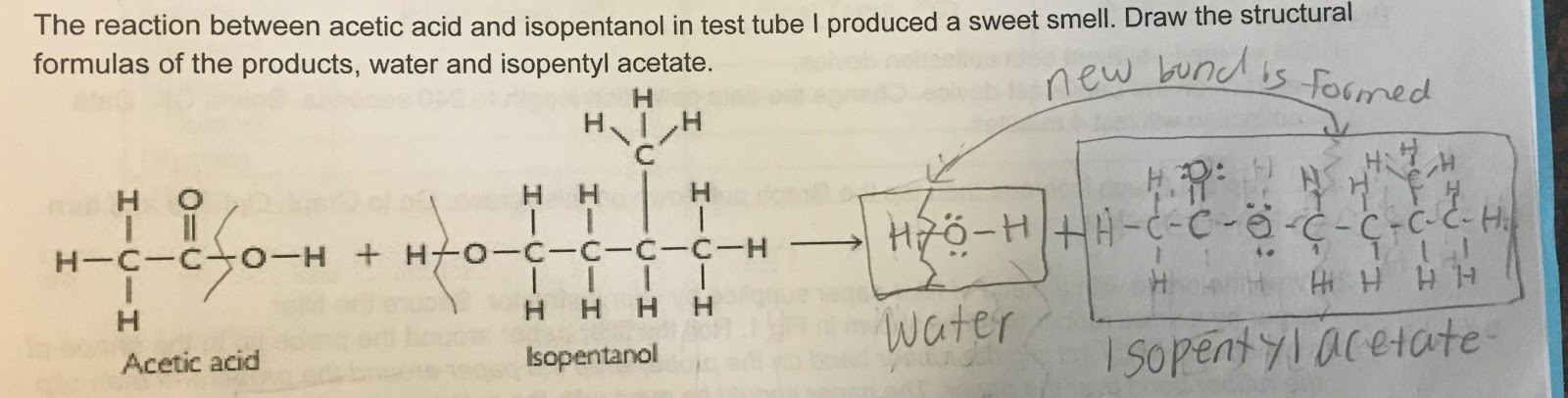
The sweet smell of the mixtures after heating indicates that ester must be present in the final molecules. This functional group is what caused the final products to smell sweet. 

Here is a picture of ester:


Were the new compounds easily identified as a specific fragrance like apple or banana? In the case where a specific fragrance was detected, how does the odor compare to the natural fragrance?
Each person had a different idea of what each substance smelled like because smell is a qualitative description of a substance, not a quantitive one. Each person has been exposed to certain smells more often than others in their lifetime, so they have different ideas on what things smell like and how fast they can identify a scent. One person could be confident in saying that something smells like banana, and not be wrong, while at the same time someone else could say that it smells like an apple, and again, not be wrong. For me, I needed to smell only once to figure out what each substance smelled like because I am very sensitive to strong scents and the substances had very strong scents. The smells from the synthesis reaction smelled the same as the natural fragrance it was identified as which I thought was pretty cool, because we had made these scents ourselves instead of just smelling something that was already made. 

Here is a picture of the finished challenge puzzle: 


Wednesday, July 5, 2017

Electron Configuration Battleship

Here is picture of my set up:


It was challenging to find the right configuration for the element you wanted to hit because this skill is so new and we are still practicing how to use the periodic table to make the configurations. It was also challenging when you had to say long configurations because it took a long time and you had to make sure you were saying the right orbits/sub levels in the right order.

During this game, I learned how to make electron configurations using the periodic table, and I was able to understand how to use the noble gas shortcut and which orbitals corresponded to certain elements.

Flame Test Lab

The purpose of the flame test lab was to see how different substances reacted when put in a flame. We were trying to see what colors each substance produced when it touched the fire and to match two unknown substances to two known substances by comparing the colors that were produced.

Pre Lab Questions:

What is the difference between ground state and an excited state?
Ground state is when all the electrons in an atom are at their lowest possible energy levels. Excited state is when the electrons in an atom have a higher energy level then their ground state energy level.

In this experiment, where are the atoms getting their excess energy from?
The atoms in this experiment are getting their excess energy from the flame they are interacting with.

Why do different atoms emit different colors of light?
Different atoms emit different colors of light because each atom has it's own unique set of electrons which when are excited produce a color of light. The different mix of energy differences for each atom produces different colors.


Here is a picture of one of the flames we tested:


Analysis Questions:

What patterns do you notice in the groupings?
Most of the solutions containing sodium produced a yellow or red color and the solutions containing copper produced a blue/green color.

What evidence do you have that atoms of certain elements produce a flame of a specific color?
When we grouped the substances based on color, certain elements were only involved in making one specific color no matter what it was mixed with. For example, copper always produced the color blue/green even though it was mixed with chloride, to make one substance, and nitrate, to make a different substance.

Can a flame test be used to identify a metal atom in a compound? Why or why not? What about a nonmetal atom?
A flame test can be used to identify a metal atom in a compound because each metal produces a different unique color, due to each metal's varying electron transitions to different energy levels when heated. A flame test can not be used to identify a nonmetal because their electrons do not undergo excitations, thereby when heated, do not produce a distinct color like the metals do. For example, in our experiment, we had the nonmetal chloride in many of our solutions and when mixed with different metals, produced many colors making it impossible to say which exact color chloride produces.

Identify the two unknowns. What are they and how do you know?
Unknown #1 was Lithium Chloride [LiCl], and we know this because when we heated the unknown substance, it produced a bright pink color that matched the color that LiCl produced when it was heated. Unknown #2 was Potassium Chloride [KCl], and we know this because when we heated the unknown, it produced a purple/lavender color which matched the color that KCl produced when it was heated.

Copper oxide, CuO, is a black solid. It doesn't look at all like the element copper. What color flame would it produce? 
Copper Oxide [CuO] would produce a blue/green flame when heated. This is because the substance has copper in it which, when we did our experiment, every time copper was involved the flame turned blue/green.

Monday, July 3, 2017

Mole-Mass Relationships Lab

The purpose of the Mole-Mass Relationships Lab was to understand limits of reactants and to understand percent yield and how to calculate it.

Here is picture of our product:


Here is a picture of our calculations:


Some possible errors in our percent yield could be that we didn't evaporate all of the water out of the solution, and the weight of our product may be a little off. We know that we could not have added too much acid to the reactant because if we had, then the product would have turned yellow, which ours did not.

Saturday, July 1, 2017

Composition of a Copper Sulfate Hydrate Lab

During the Composition of a Copper Sulfate Hydrate Lab, we heated some copper sulfate on a hot plate until all of the water had evaporated and all that was left was only the copper and the sulfate.

Here is a picture before we heated the copper sulfate:


Here is a picture after we heated the copper sulfate:


Here is a picture of our calculations:


We had a pretty high percent error and a couple reasons for that could be that we had too much of the substance in our sample [we had almost the max amount], and the weight of our substance hydrated/anhydrated could be a little off, making the percent error higher than it should be.


Here is a picture of our calculations to figure out the empirical formula of the hydrate:

Mole Baggie Lab

During the Mole Baggie Lab we had to find the identity of two bags filled with different substances. We were given different information about each bag and had to find out more information using balances and proportions. We were also given five possible substances that could be in our bag so we first had to figure out the formulas for each of the substances and their grams per mole so we could match the substance in our bag's grams per mole to one of the possible substances' grams per mole.

My partner and I started by identifying what was in bag B2; the mass of the empty bag [2.57 grams] and the number of representative particles [3.10 x 10^22] were already given to us. We weighed the bag with the substance inside and figured out how much it weighed [5.52 grams], then subtracted the mass of the empty bag from the mass of the full bag to figure out how much the substance weighed [2.95 grams]. Now we knew that the mass of the substance was 2.95 grams but we still did not know what the molar mass was so we set up an equation using Avogadro's number to figure out that it was 0.0514 grams per mole. We then set up another proportion using the mass of the substance and the molar mass to find out how many grams per mole our substance had [2.95/0.0514] which ended up being 57.39 grams per mole. Now that we knew how many grams per mole was in our substance, we just had to match it to one the possible substances that we had to choose from. 57.31 grams per mole is very similar to 58.44 grams per mole, so we said that bag label B2 was Sodium chloride [NaCl].

After we figured out what was in bag B2, we had to figure out what was in bag A5; the mass of the empty bag [2.56 grams] and the molar mass [0.025 grams per mole] were given to us. We weighed the bag with the substance inside to figure out how much the full bag weighed, [4.71 grams] then subtracted the mass of the empty bag from the mass of the full bag to figure out how much the substance weighed [2.15 grams]. Now that we knew the mass of the substance and the molar mass, we just set up a proportion to figure out how many grams per mole there was in the substance, [2.15/ 0.025] which ended up being exactly 86 grams per mole. Now that we knew how many grams per mole was in our substance, we just had to match it to one of the possible substances we had to choose from. 86 grams per mole is similar to 81.41 grams per mole, so we said that bag A5 was Zinc oxide [ZnO].

Bag B2 was Sodium Chloride [NaCl].
Bag A5 was Zinc Oxide [ZnO].

Here is picture of our calculations:

Titration Lab

During the titration lab, we had to determine the percentage ionization of acetic acid in vinegar. We did this by titrating the acetic acid ...